


26th October 2026
 7 mins
How do we assess creativity without losing rigour?
I’m going to be bold and say it: in too many prep schools, assessment is still mostly about judging memory. It tells us what a child can recall on a Tuesday morning in a hall. It tells us far less about where that child started, how far they have travelled, or whether they can think for themselves.
I would like to see it the other way round. We should be identifying each child’s starting point, understanding their individual learner profile and tracking their progress against that, rather than trying to fit them to a model that is not going to work for them. Independent schools, with our smaller classes, should be doing this a lot better than we are.
That matters more than ever. In April, Highfield School, led by our Head, Suzannah Cryer, hosted the Raising the Future conference, bringing together educators, employers and policymakers to ask how education must change ahead of the national curriculum reforms due in 2028. We never wanted it to be a one-day-and-done event. The white paper we submitted to the Secretary of State recommends reducing the reliance on high-stakes terminal exams and expanding project-based and oral assessment, so that creativity and independent thinking count alongside knowledge. The campaign continues, and this is my small contribution to it from the classroom.
Creativity and rigour are not rivals
Here is the question I get asked most: how on earth do you assess creativity? And the follow-up, usually from a sceptic: doesn’t it come at the expense of rigour?
My answer, after three years of running the ISEB’s Independent Project Qualification (IPQ) with our Year 8s, is that the two are not in tension at all. They work best together.
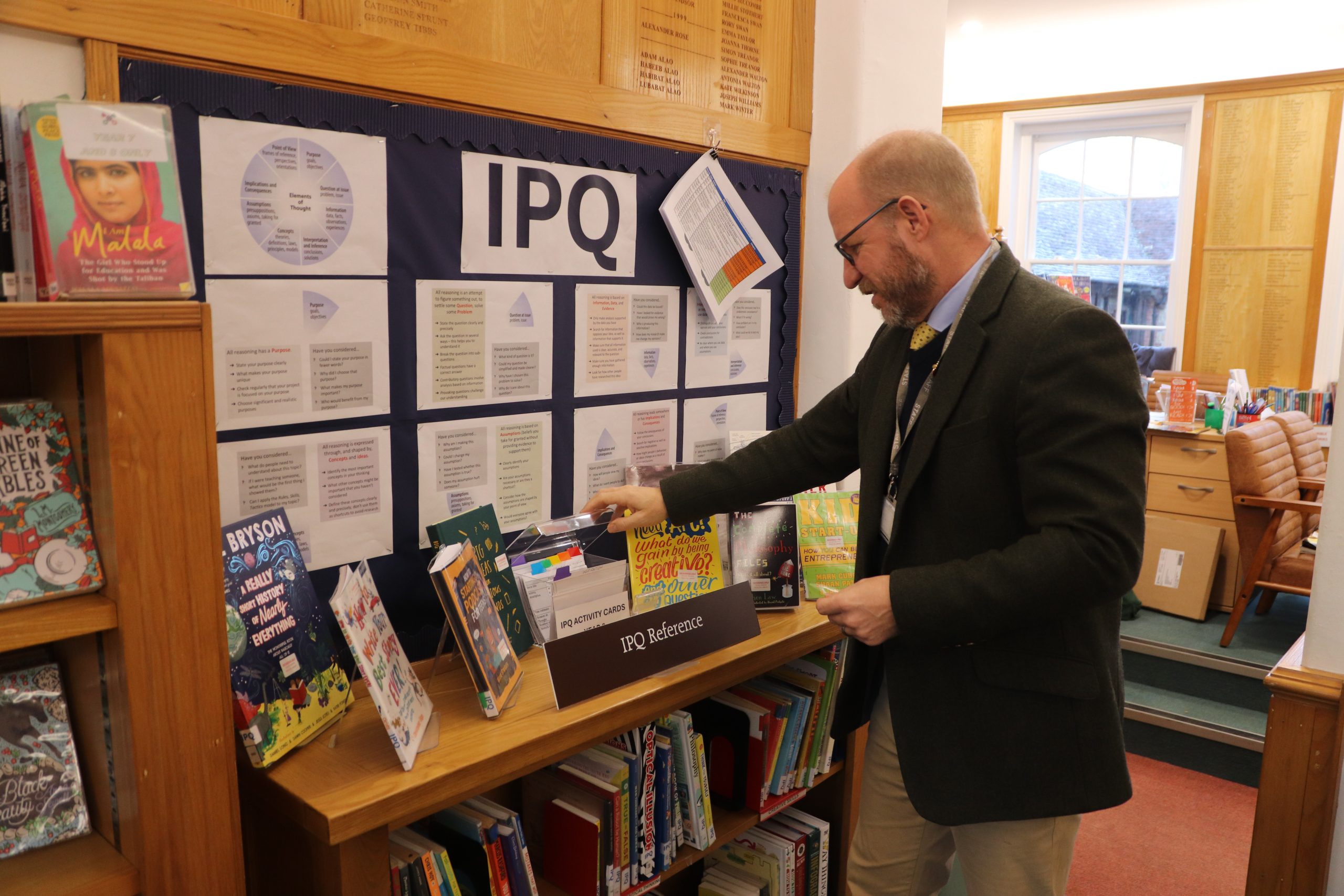
For those who don’t know it, the ISEB Project Qualification asks each pupil to choose a title, framed as a question, linked to something they are passionate about. They then research it and build a persuasive argument towards a conclusion that points back to that title, using a framework that gives the project its structure. Every stage is designed to be AI resistant. At the end, projects from prep schools across the UK are graded through the ISEB’s Comparative Judgement Model, which compares them against each other to give a fair and accurate result. Our pupils meet Socratic questioning from their very first session, and we challenge them to convince us of their project’s worthiness using “anything but words on a page”.
There is plenty of creative freedom, especially when undertaking primary research, from portfolios, prototype designs and diaries to surveys, podcast-style interviews, museum visits and data analysis, as well as the traditional essay.
The titles our pupils choose say a great deal:
- Is modern art a genuine form of expression or is it driven by profit and prestige?
- Should hypnosis really be something in the hands of our society or is it something too dangerous?
- To what extent is horse cloning acceptable?
- Should we be investing money in space or solving problems on earth instead?
- Since everyone has a camera on their phone, can taking photos still be called art?
- How can we make the SEN budget more effective?
- Does fighting in ice hockey add to the sport’s culture or undermine its integrity?
These are not topics I handed out. Every one began with a child’s own passion, and every one is a real question with no easy answer, which the pupil then had to research, argue and defend. Some are playful and some are weighty, but all are serious.
Seven swimming costumes
Let me tell you about one of our pupils this year. She is a very strong swimmer, and her project question was whether the performance of today’s athletes is down to technology. Most of us would have gone to the library, and she did too. But she also tracked down seven different swimming costumes, going back as far as the 1820s, and tested her own speed in each of them. That is creativity. It is also a controlled comparison, a hypothesis and a method, which is rather good science. She would come up to me and say, “Sir, I’ve really learned more about this.” A couple of weeks later she would say it again. Nobody had to ask her to go deeper. The question was hers, so she wanted to.
This is what the sceptics miss. Project-based learning is not a watered-down version of the curriculum. Done properly, it asks children to think at a far higher level than much of their day-to-day subject learning. The IPQ gives us a framework that is demanding: a structured scheme of work, real research skills, and deadlines that do not bend. The reflection at each stage matters far more than any grade I give. We do attach an objective mark, so children know where they are tracking. But when a pupil starts to see, in their own reflections, that they are falling behind, that is the real lesson. I remind them that at university, a missed deadline gets you pretty much zero. Better to hear that at thirteen than at nineteen!
A word to parents, because I know the mark matters to you too. We do give an objective grade, so that you and your child can see where they are tracking- I think that is helpful. But the number is not the point. What I would ask you to look for is a child who is learning to reflect, to meet a deadline and to keep going when it gets difficult, and who is being shown at a young age the expectations they will meet when they are older.
The Exhibition
The project ends with our Exhibition in May, and this is where the creativity really comes alive. Pupils set up their own stands and present their findings to their peers, teachers, parents and visiting senior school staff. It is the equivalent of a viva at the end of a PhD, and the children are free to decide how they present. We have had videos, crafted costumes, live cooking demonstrations and fascinating artefacts. What I love most is that they light up. They are so wrapped up in their passion and pride in the project that they forget they are doing something formal at all. I can think of few better places to see creativeness and academic rigour sitting side by side.
The grades bear this out. Among last year’s Year 8s, nearly a third (29%) achieved a Distinction and almost half (46%) a Merit, with the remaining 25% achieving a Pass. Every one of them came out with a nationally recognised qualification.
What about the exams?
I want to be clear that knowledge remains vital. I am not dismissing it. But last year, I had 56 Year 8s sitting their Common Entrance papers, and all bar one have exceeded 55%. Three years ago, I did not have that. The study habits, the intellectual curiosity and the resilience the IPQ builds are exactly what a generation that find studying tricky need. Creativity and rigour, in the same programme, lifting the same children.
So how do we assess creativity? We stop trying to catch it in a single exam, and we build a system that lets it show itself: a child’s own question, a rigorous process, honest reflection, and a teacher who knows where that child began. If your school’s assessment model is not working for the children in front of you, make a bold move away from it. Please don’t keep repeating something just because it has been done for a hundred years.
I would bet my house that if you asked every prep school child in the country whether they would rather have a day of Maths, English, and Science, or a project on something they are passionate about, they would jump at the project. I see it every September, when the Year 8s learn they can choose their own topic and every face lights up. I’d say that is a good place to start.
And colleagues, I promise you: it has re-energised my own teaching after nearly thirty years. It could do the same for yours.